

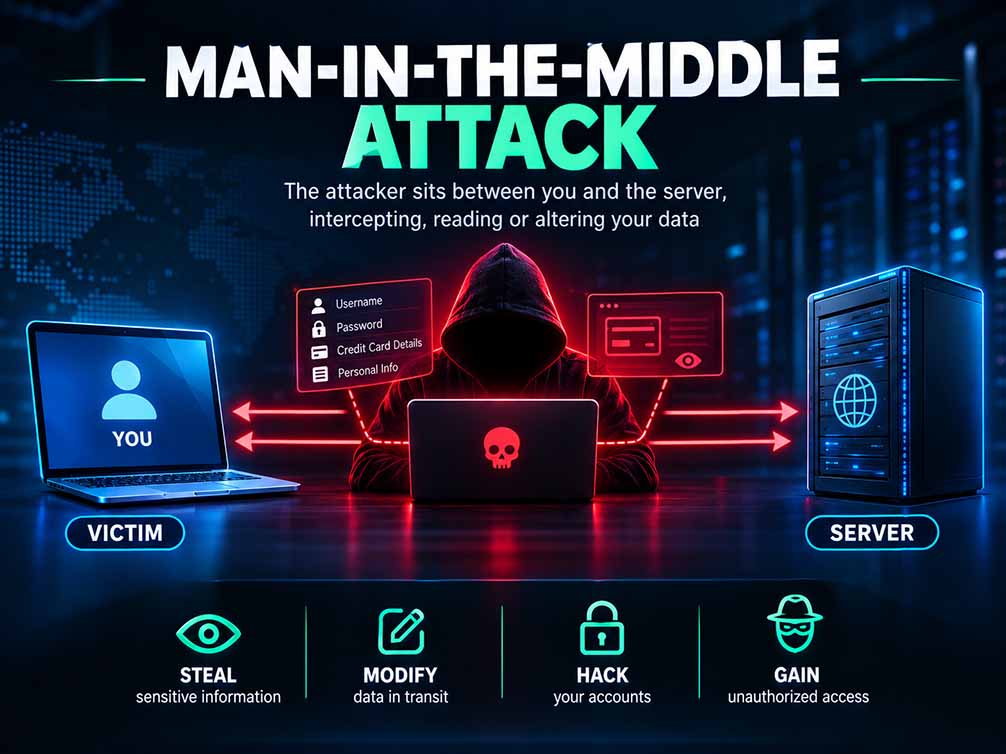
Imagine sending a private message to your bank, your doctor, or your business partner. You hit send, confident the message travels directly to them. What you cannot see is a third person sitting invisibly between you and the recipient, reading every word, potentially rewriting it, and passing it along as if nothing happened.
That is a man-in-the-middle attack in its simplest form.
MITM attacks are among the oldest and most dangerous techniques in a hacker’s arsenal. They are not theoretical threats reserved for espionage thrillers. They happen every day, on public WiFi networks at coffee shops, inside corporate networks, on mobile devices, and even across encrypted connections when attackers know exactly what they are doing.
This guide covers everything: what MITM attacks are, every major technique attackers use, real-world examples that caused serious damage, how to detect an attack in progress, and most importantly, how to protect yourself and your organization with actionable, proven strategies.
Whether you are a complete beginner trying to understand the basics or a security professional looking for deeper technical insight, this resource has been built specifically for you.
We've done the vetting. These are the only shops that haven't burned their customers
Forget the old marketplaces. These are the next generation. Faster, safer, better product. This is where the smart money moves. Don't get left behind.
Buyccfullz.com
No waiting, no middlemen. This site moves money. Click and collect..
Dumpseller.com
Clean, verified routes. dumpseller.com keeps the cash flowing. No blocks. No holds.
CvvDump.com
Turn digits into dollars. cvvdump.com is the key to the kingdom. Your wallet stays full.
1. What Is a Man-in-the-Middle Attack?
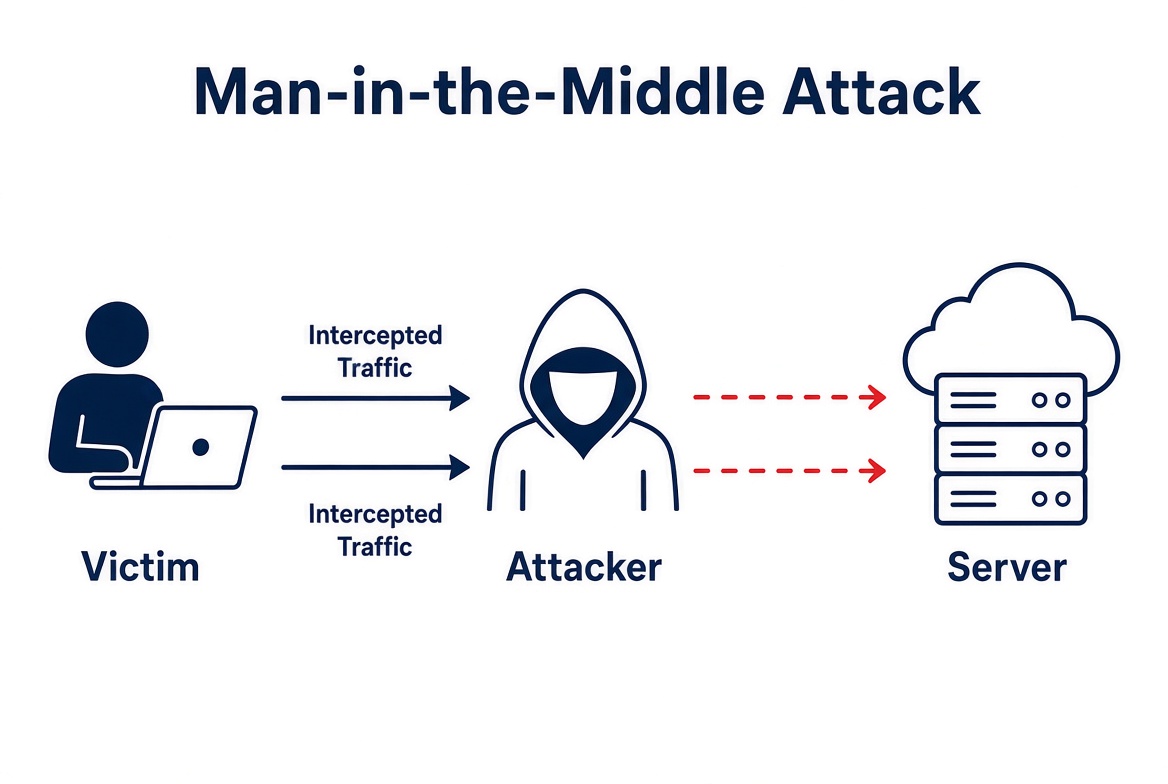
A man-in-the-middle attack, commonly abbreviated as MITM, is a cyberattack where a malicious actor secretly intercepts and potentially alters communications between two parties who each believe they are communicating directly and privately with each other.
The attacker positions themselves between the sender and receiver like an invisible relay station. Every packet of data that flows between the two parties passes through the attacker first. They can read it, copy it, modify it, or block it entirely, all without either victim realizing anything is wrong.
The core danger of a MITM attack is not just eavesdropping. It is the illusion of secure, direct communication. Both parties trust that their connection is private. That misplaced trust is exactly what the attacker exploits.
What Data Can Attackers Steal?
The type of data exposed in a MITM attack depends heavily on the nature of the communication being intercepted. Common targets include:
- Login credentials (usernames and passwords)
- Banking and financial transaction details
- Credit card numbers and personal account data
- Private emails and chat messages
- Session tokens and authentication cookies
- Corporate trade secrets and sensitive documents
- Healthcare records and personally identifiable information (PII)
- API keys and access tokens used by developers
Also Read: How Carders Obtain Credit Card Data
The Three Phases of Every MITM Attack
Every man-in-the-middle attack follows a general three-phase structure regardless of the specific technique used:
- Interception — The attacker inserts themselves into the communication path, capturing traffic that was never meant for them.
- Decryption — If the traffic is encrypted, the attacker works to decrypt it or downgrade the connection so encryption is bypassed entirely.
- Execution — The attacker either passively collects stolen data or actively manipulates the communication to achieve a specific goal, such as injecting malicious content or redirecting a financial transaction.
2. How Does a MITM Attack Work? Step-by-Step
Understanding the mechanics of a MITM attack helps demystify something that can sound abstract. Here is a straightforward walkthrough of how a typical attack unfolds.
Step 1: The Attacker Selects a Target Environment
The attacker identifies a network or communication channel where they can plausibly insert themselves. Public WiFi networks, poorly secured corporate networks, and home routers with default passwords are common entry points.
Step 2: Interception Is Established
Using one of several techniques (ARP spoofing, DNS spoofing, rogue access points, etc.), the attacker redirects network traffic through their own device. To the victim, the network still appears to function normally. To the attacker, every data packet is now flowing through their machine first.
Step 3: The Attacker Handles Both Sides of the Conversation
This is where the “middle” truly comes into play. The attacker maintains two simultaneous connections: one with the victim and one with the legitimate server or recipient. They relay messages between both parties, making the communication appear normal and uninterrupted.
Step 4: Data Is Captured or Manipulated
With full visibility into the communication stream, the attacker can record everything passing through. Depending on their goal, they may:
- Log credentials quietly without disrupting the session
- Inject malicious scripts into web pages the victim loads
- Alter financial transaction details (changing an account number, for instance)
- Serve fake login pages to harvest credentials in real time
Step 5: The Attack Concludes (Often Undetected)
Many MITM attacks leave no obvious trace. The victim completes their session, logs out, and walks away with no awareness that their credentials, financial data, or private communications were just silently extracted.
3. Types of Man-in-the-Middle Attacks
MITM is not a single technique. It is a category of attack that encompasses many different methods, each exploiting a different vulnerability in how networks and protocols operate.

ARP Spoofing Attack
ARP stands for Address Resolution Protocol. It is the mechanism networks use to map IP addresses to MAC addresses (the physical identifiers of network devices). ARP has a fundamental weakness: it is stateless and trusting. Any device on a local network can send ARP replies claiming any IP address belongs to any MAC address, and most systems will simply believe it.
In an ARP spoofing attack, the attacker broadcasts fake ARP messages across the local network. They tell every device that the attacker’s MAC address corresponds to the IP address of the default gateway (your router). Simultaneously, they tell the router that their MAC address corresponds to the victim’s IP.
The result is that all traffic from the victim to the internet, and from the internet back to the victim, now flows through the attacker’s machine. The victim notices nothing because the attacker dutifully forwards all packets to their correct destinations.
Why it is dangerous: ARP spoofing is the foundational technique behind many other MITM attacks on local networks. It is fast to execute and effective against the vast majority of unprotected networks.
DNS Spoofing Attack
DNS (Domain Name System) translates human-readable domain names like www.yourbank.com into the IP addresses computers actually use to connect. DNS spoofing, also called DNS cache poisoning, involves injecting false DNS records into a resolver’s cache.
When a victim’s device looks up the IP address for a legitimate website, the poisoned DNS server returns a fraudulent IP address controlled by the attacker instead. The victim’s browser connects to the attacker’s server, which displays a convincing replica of the legitimate site. Every credential entered goes directly to the attacker.
Why it is dangerous: DNS spoofing can redirect massive numbers of users simultaneously, not just individual victims. Entire ISPs and enterprise networks have been targeted. The user sees the correct domain name in their browser, making deception extremely convincing.
SSL Stripping Attack
HTTPS provides encrypted communication between your browser and a web server. SSL stripping is an attack that silently downgrades that encrypted HTTPS connection to an unencrypted HTTP connection, often without the victim noticing.
The attack was first demonstrated publicly by security researcher Moxie Marlinspike in 2009 and remains relevant today wherever HSTS (HTTP Strict Transport Security) is not properly implemented.
Here is how it works: when you type yourbank.com into your browser, your browser first makes an unencrypted HTTP request before being redirected to HTTPS. The attacker intercepts that initial unencrypted request, establishes their own HTTPS connection with the legitimate server, and then maintains a plain HTTP connection with the victim. The attacker sees everything in plaintext.
Why it is dangerous: Users often do not check for the padlock icon or notice the absence of HTTPS in their address bar. The page loads and functions normally. Credentials entered travel in plaintext directly to the attacker.
Session Hijacking Attack
When you log into a website, the server creates a session and assigns your browser a session token, typically stored as a cookie. This token is how the server recognizes you as an authenticated user for the duration of your visit, without requiring you to re-enter your password on every page.
Session hijacking involves stealing that token. Once an attacker has your session cookie, they can present it to the server and the server treats them as you, fully authenticated, with no password required.
Tokens can be stolen through packet sniffing on unencrypted connections, through cross-site scripting (XSS) attacks, or through MITM interception on compromised networks.
Why it is dangerous: Session hijacking gives an attacker full authenticated access to your accounts. Banking portals, email accounts, corporate dashboards, and cloud services are all vulnerable if session management is weak and transport encryption is absent or stripped.
Evil Twin Attack
An evil twin attack involves setting up a rogue WiFi access point that mimics a legitimate one. The attacker names their hotspot identically to a real network (such as “Starbucks_WiFi” or “AirportFreeWiFi”) and often broadcasts a stronger signal to attract connections.
When an unsuspecting user connects to the evil twin network, all their internet traffic flows through the attacker’s device. The attacker can intercept login credentials, inject content into web pages, and monitor browsing activity in real time.
Evil twin attacks require minimal technical skill and very inexpensive hardware, making them particularly widespread.
Why it is dangerous: Most devices automatically connect to saved networks by name without verifying authenticity. A user who connected to the real airport WiFi yesterday may automatically reconnect to the attacker’s evil twin today without any prompt whatsoever.
BGP Hijacking
Border Gateway Protocol (BGP) is the routing protocol that governs how data is directed across the internet at the largest scale. It determines which paths internet traffic takes between autonomous systems (the large networks operated by ISPs, cloud providers, and governments).
BGP hijacking occurs when a malicious actor (or a compromised network operator) announces false routing information, tricking the global internet into routing traffic through their infrastructure. This is MITM at an internet-wide scale.
BGP hijacking incidents have affected major companies including Amazon, Google, and financial institutions. In 2018, traffic to Amazon Route 53 DNS servers was briefly hijacked in an attack that redirected cryptocurrency wallet users to a phishing site, resulting in real financial losses.
Why it is dangerous: BGP hijacking operates at a scale that individual users and even large organizations cannot defend against independently. It requires action from ISPs and internet infrastructure operators to mitigate.
HTTPS Downgrade Attack
Closely related to SSL stripping, an HTTPS downgrade attack specifically targets the negotiation between a client and server over which version of TLS (Transport Layer Security) to use. Older protocol versions like TLS 1.0 and SSL 3.0 contain known vulnerabilities (POODLE, BEAST, CRIME) that attackers can exploit once they force both parties to communicate using a weakened protocol.
Why it is dangerous: Even websites that appear to use HTTPS can be vulnerable if they still support deprecated protocol versions as a fallback for compatibility reasons.
Packet Sniffing Attack
Packet sniffing itself is not inherently malicious. Network administrators use packet capture tools like Wireshark every day for legitimate diagnostic purposes. However, in the wrong hands, packet sniffing becomes a powerful passive MITM technique.
On unencrypted networks, every data packet traveling across the wire or through the air can be captured and read in plaintext by anyone with the right tools and network access. Credentials, messages, form submissions, and cookies all pass through in the open.
On encrypted networks, packet sniffing without additional interception techniques yields only ciphertext, which is essentially useless without the corresponding decryption keys. This is why encryption is fundamental to network security.
Why it is dangerous: On public WiFi or misconfigured networks, a passive attacker can collect enormous amounts of sensitive data without sending a single packet themselves, making detection extremely difficult.
Email MITM Attack
Email MITM attacks target the communication between email clients and mail servers, or between two parties exchanging business emails. Common techniques include:
- SMTP downgrade attacks: Forcing email servers to communicate without TLS encryption
- Email account compromise: Gaining access to a mailbox and silently forwarding or modifying messages
- Business Email Compromise (BEC): Impersonating executives or vendors to redirect payments
BEC attacks caused over $2.9 billion in losses in the United States in 2023 according to FBI Internet Crime Complaint Center (IC3) reporting, making email-based interception and impersonation one of the most financially devastating forms of MITM in practice today.
MITM Attacks on IoT Devices
The Internet of Things (IoT) encompasses billions of connected devices: smart thermostats, security cameras, medical devices, industrial control systems, and more. Many of these devices were designed with functionality as the primary priority and security as an afterthought.
Common IoT MITM vulnerabilities include:
- Lack of certificate validation (accepting any certificate presented)
- Hardcoded credentials that cannot be changed
- Unencrypted communication protocols
- No mechanism for firmware updates
- No protection against ARP or DNS spoofing
An attacker who successfully intercepts communication to and from a smart home security camera gains a live feed of the home’s interior. An attack against industrial IoT devices in a manufacturing environment can cause physical equipment damage or shut down production lines entirely.
Also Read: Credit Card Fraud Protection
4. Real-World MITM Attack Examples
Theory becomes far more tangible when grounded in documented incidents.
The Superfish Incident (2015)
Lenovo pre-installed adware called Superfish on consumer laptops. Superfish installed its own root certificate authority into Windows, enabling it to intercept HTTPS connections and inject advertisements into web pages. This was a textbook SSL MITM attack executed by the device manufacturer itself, affecting potentially millions of users. Security researchers discovered the vulnerability and Lenovo issued an emergency removal tool, but not before widespread exposure.
DigiNotar Certificate Authority Breach (2011)
Dutch certificate authority DigiNotar was compromised by attackers who issued fraudulent SSL certificates for major domains including Google.com. These certificates allowed attackers (likely state-sponsored) to conduct MITM attacks against approximately 300,000 Iranian Gmail users, intercepting their encrypted communications entirely. DigiNotar subsequently went bankrupt as a result of the breach.
Amazon Route 53 BGP Hijack (2018)
Attackers hijacked BGP routes pointing to Amazon’s Route 53 DNS infrastructure for approximately two hours. The hijack redirected users attempting to access a cryptocurrency wallet service (MyEtherWallet) to an attacker-controlled server. Users who entered credentials lost cryptocurrency holdings. Estimated losses exceeded $150,000 in Ether.
Operation Socialist — GCHQ and Belgacom (2013)
Documents revealed by Edward Snowden indicated that British intelligence agency GCHQ conducted a sophisticated MITM attack against Belgian telecommunications provider Belgacom. By compromising internal systems and intercepting traffic, intelligence operatives gained access to communications routed through the Belgacom network. This case illustrated that nation-state actors operate MITM attacks at infrastructure scale.
NSA QUANTUM Program
Further Snowden revelations disclosed the NSA’s QUANTUM program, which involved large-scale interception of internet traffic at fiber optic cable junctions and injection of malicious content into unencrypted sessions. This represented MITM at a truly global scale targeting foreign intelligence subjects.
5. MITM Attack Tools Used by Hackers and Security Researchers
Understanding which tools are used in MITM attacks is valuable for security professionals, penetration testers, and IT administrators who need to test their own network defenses. All tools mentioned below are used in legitimate security research and authorized penetration testing contexts.
Wireshark
Wireshark is the world’s most widely used network protocol analyzer. It captures packets traversing a network interface and presents them in a highly readable format. Security professionals use Wireshark to diagnose network problems, analyze protocol behavior, and identify plaintext credentials or suspicious traffic patterns during security audits.
Ettercap
Ettercap is a comprehensive suite specifically designed for MITM attacks on local area networks. It supports ARP poisoning, DNS spoofing, and several active attack modes. It is almost exclusively used in controlled lab environments and authorized penetration testing engagements.
Bettercap
Bettercap is a modern, modular network attack and monitoring tool that supersedes much of Ettercap’s functionality. It supports WiFi scanning, ARP spoofing, DNS spoofing, HTTPS proxying, and Bluetooth reconnaissance. Security researchers use it extensively for wireless network auditing.
mitmproxy
mitmproxy is an interactive, scriptable proxy tool that allows security professionals to intercept, inspect, modify, and replay HTTP and HTTPS traffic. It is widely used in web application security testing and API security research.
SSLstrip
Originally developed by Moxie Marlinspike, SSLstrip automates the SSL stripping attack. It transparently hijacks HTTP traffic on a network, watching for HTTPS links and redirects, then transparently strips the encryption. Its existence drove the development and adoption of HSTS as a countermeasure.
6. Who Is Most at Risk?
While anyone connected to a network carries some degree of MITM exposure, certain groups face significantly elevated risk.
High-Risk Individuals and Organizations:
- Remote workers connecting to corporate systems over public or unsecured networks
- Frequent travelers who regularly use hotel, airport, or cafe WiFi
- Financial professionals handling sensitive transactions online
- Healthcare providers transmitting patient records electronically
- Journalists and activists in high-surveillance environments
- Small and medium businesses with limited dedicated security staff
- IoT-heavy environments like smart offices, hospitals, and factories
- Developers who handle API keys, tokens, and cloud credentials
- Cryptocurrency users making transactions over untrusted networks
7. How to Detect a Man-in-the-Middle Attack
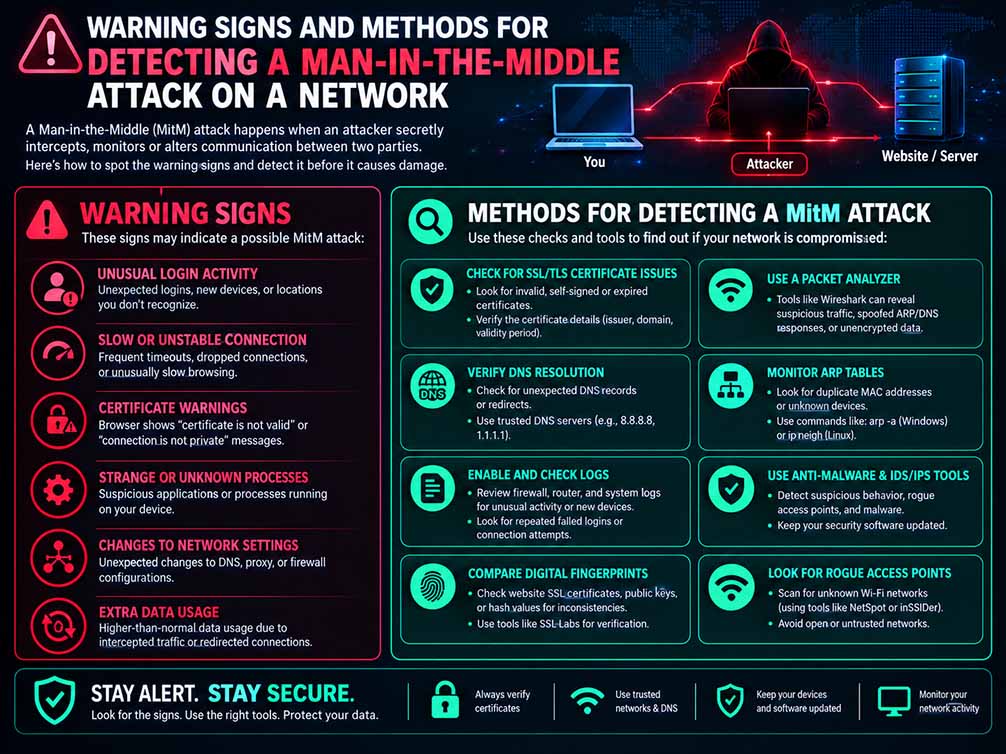
Detection is genuinely challenging because sophisticated MITM attacks are specifically designed to be transparent to both parties. However, several indicators can reveal an attack in progress.
Browser and Certificate Warnings
Your browser displays certificate warnings when the presented SSL/TLS certificate does not match what is expected. A sudden, unexpected certificate warning on a site you visit regularly is a serious red flag. Do not click through it. Investigate.
Unexpected SSL Certificate Changes
Security teams can monitor the SSL certificates presented by their web properties and third-party services they interact with. An unexpected change in certificate issuer, fingerprint, or validity period may indicate a MITM attack.
Unusual Network Latency
MITM attacks introduce an additional hop in the communication path. Unexpected increases in network latency, particularly on local networks, can sometimes indicate traffic is being routed through an unintended intermediary.
ARP Table Anomalies
On local networks, administrators can inspect ARP tables for duplicate MAC address entries. If two different IP addresses share the same MAC address in the ARP cache, ARP spoofing is likely occurring.
Command to check ARP table (Windows): arp -a

Command to check ARP table (Linux/macOS): arp -n
Intrusion Detection Systems (IDS)
Tools like Snort, Suricata, and enterprise SIEM platforms can be configured to detect ARP spoofing patterns, unusual DNS responses, SSL certificate anomalies, and other MITM indicators automatically.
Network Monitoring Tools
Tools like Arpwatch monitor ARP traffic on a network and alert administrators when MAC-to-IP mappings change unexpectedly, which is a primary symptom of ARP poisoning.
8. How to Prevent MITM Attacks: Complete Defense Strategy
Prevention is far more effective than detection and response. A layered security approach provides the strongest protection against the broad range of MITM techniques.
Use a Reliable VPN
A Virtual Private Network encrypts all traffic between your device and a VPN server before it reaches the open internet. Even if an attacker successfully intercepts your traffic on a local network or public WiFi, they receive only encrypted ciphertext they cannot practically decrypt.
Key considerations when choosing a VPN:
- Choose providers with a verified no-logs policy
- Prefer VPNs that use WireGuard or OpenVPN protocols
- Avoid free VPN services, which frequently monetize user data
- Ensure the VPN uses strong encryption (AES-256 or ChaCha20)
Always Use HTTPS
Only submit sensitive information on sites that use HTTPS. The padlock icon and HTTPS prefix in your browser’s address bar confirm that your connection to the server is encrypted. Browser extensions like HTTPS Everywhere (now largely superseded by built-in browser functionality) enforced HTTPS connections automatically.
Implement HSTS (HTTP Strict Transport Security)
For website operators and developers, HSTS is a critical defense against SSL stripping. It instructs browsers to only ever connect to a domain over HTTPS, refusing any HTTP connection. Once a browser has received an HSTS header for a domain, it will not make unencrypted connections to that domain, even if instructed to by a redirect.
Submitting your domain to the HSTS preload list (hstspreload.org) provides maximum protection by hardcoding your domain into browsers before any connection is ever made.
Enable Certificate Pinning
Certificate pinning instructs an application to only accept a specific, pre-approved certificate or public key when connecting to a server, rather than trusting any certificate signed by any recognized certificate authority.
This is particularly important for mobile applications handling sensitive data. Certificate pinning defeats SSL MITM attacks that rely on fraudulent certificates issued by compromised or rogue certificate authorities.
Use DNSSEC
DNS Security Extensions (DNSSEC) add cryptographic authentication to DNS responses, making DNS spoofing and cache poisoning dramatically more difficult. Website owners should enable DNSSEC on their domains. Users benefit when their DNS resolver also validates DNSSEC signatures.
Implement Multi-Factor Authentication (MFA)
Even if an attacker successfully captures login credentials through a MITM attack, MFA provides a second barrier. Time-based one-time passwords (TOTP) and hardware security keys (like YubiKey) are significantly more resistant to MITM than SMS-based two-factor authentication.
Note: SMS-based 2FA is vulnerable to SIM swapping and some real-time MITM phishing kits that can relay OTP codes before they expire. Hardware keys offer the strongest protection.
Avoid Public WiFi for Sensitive Activities
If you must use public WiFi, do so only with an active VPN connection. Never conduct banking, enter passwords, or access sensitive professional systems on open public networks without VPN protection.
Use Secure DNS Resolvers
Configure your devices and routers to use DNS over HTTPS (DoH) or DNS over TLS (DoT) resolvers. These protocols encrypt DNS queries, preventing DNS spoofing and eavesdropping on your browsing activity. Providers like Cloudflare (1.1.1.1), Google (8.8.8.8), and Quad9 (9.9.9.9) offer encrypted DNS resolution.
Keep Software and Firmware Updated
Many MITM attack techniques exploit known vulnerabilities in outdated operating systems, browsers, network firmware, and application software. Regular updates patch these vulnerabilities before attackers can exploit them.
Deploy Network Monitoring and Intrusion Detection
Organizations should implement continuous network monitoring to detect ARP spoofing, unexpected certificate changes, unusual traffic patterns, and other MITM indicators in real time. Enterprise solutions from vendors like Darktrace, CrowdStrike, and Palo Alto Networks provide sophisticated behavioral detection capabilities.
Use Email Security Protocols
To defend against email-based MITM and impersonation attacks, implement:
- SPF (Sender Policy Framework): Specifies which mail servers may send email on behalf of your domain
- DKIM (DomainKeys Identified Mail): Adds a cryptographic signature to outgoing emails, verifying they were not tampered with in transit
- DMARC: Ties SPF and DKIM together with a policy that instructs receiving servers how to handle unauthenticated email
- MTA-STS: Enforces TLS encryption for inbound email delivery to your domain
Also Read: How to Spot Phishing Emails
9. Common Mistakes That Leave You Vulnerable
Clicking through SSL certificate warnings. Browser certificate warnings exist for a reason. Bypassing them on banking, email, or work systems is one of the most dangerous things a user can do.
Using the same password across multiple services. If credentials are stolen via a MITM attack on one platform, attackers will immediately test them on banking, email, and corporate portals. Password managers and unique passwords per service limit this exposure dramatically.
Trusting any WiFi network that appears legitimate. Network names (SSIDs) can be freely duplicated by anyone. Verify with staff before connecting to any business or venue WiFi, and always use a VPN regardless.
Ignoring software and router firmware updates. Routers running outdated firmware are frequently vulnerable to well-documented exploits that attackers use to establish network-level MITM positions.
Using outdated applications that do not validate certificates. Many older applications accept any SSL certificate presented without validation, making them trivially vulnerable to SSL MITM attacks even when connections appear encrypted.
Relying solely on SMS for two-factor authentication. SMS-based codes can be intercepted or bypassed in advanced real-time MITM phishing attacks. Hardware security keys or authenticator apps provide substantially stronger protection.
Assuming corporate networks are inherently safe. Internal network threats are real. An insider threat, a compromised device, or a misconfigured switch can enable ARP-based MITM attacks inside a corporate network just as easily as on public WiFi.
10. Pro Tips from Cybersecurity Experts
Use DNS over HTTPS everywhere. Browser-level and system-level DoH implementation prevents DNS-based eavesdropping even when the network itself is compromised.
Regularly audit certificates using tools like SSL Labs. Qualys SSL Labs (ssllabs.com/ssltest) provides free, detailed analysis of your domain’s TLS configuration, identifying weaknesses before attackers do.
Prefer hardware security keys for authentication. FIDO2 hardware keys are phishing-resistant and immune to credential relay attacks that fool even sophisticated users.
Segment your IoT devices onto a separate VLAN. Keeping IoT devices network-isolated from primary work and personal devices limits the blast radius if a smart device is compromised and used as a MITM pivot point.
Monitor your network’s ARP table regularly. Small businesses and home power users can configure periodic ARP table checks to catch ARP poisoning early.
Test your own environment. Authorized internal penetration testing using tools like Bettercap in a controlled lab environment reveals exactly what an attacker could see on your network before a real attacker finds out first.
Review your browser’s trusted certificate authorities. Periodically auditing the certificate authorities trusted by your browser and operating system can reveal rogue or compromised CAs that could be leveraged for SSL MITM attacks against you.
11. MITM Attacks on Mobile Devices
Mobile devices are an increasingly attractive MITM target. Smartphones and tablets connect to dozens of different networks weekly, often automatically reconnecting to saved network names without user confirmation.
Key mobile MITM risks:
- Automatic WiFi reconnection: Devices connect silently to known network names, facilitating evil twin attacks
- Poorly coded apps: Many mobile applications still use certificate validation incorrectly or not at all
- Cellular network interception: IMSI catchers (Stingrays) are devices used to impersonate cellular towers, intercepting mobile communications at the carrier level
- Bluetooth-based attacks: Bluetooth MITM attacks can intercept communications between devices paired on short-range wireless connections
Mobile MITM protection strategies:
- Disable auto-connect for WiFi networks
- Use a VPN that auto-connects whenever you leave trusted home networks
- Keep your mobile OS updated
- Only install applications from official app stores
- For high-risk users, consider mobile threat defense (MTD) solutions
12. Man-in-the-Middle Attacks in Banking and Finance
The financial sector is among the most heavily targeted by MITM attackers because the potential reward, direct access to monetary accounts and transactions, is immediately valuable.
How MITM Targets Banking Sessions
Browser-based banking MITM attacks typically follow this pattern: the attacker uses SSL stripping or a fraudulent certificate to intercept a banking session, then reads or alters transaction details in real time. Sophisticated attacks modify displayed account numbers during a transfer confirmation screen while sending entirely different routing instructions to the bank’s server.
This technique, sometimes called a Man-in-the-Browser (MitB) attack when executed through a compromised browser extension or banking Trojan, is particularly insidious because the user sees a confirmation screen showing the correct payee while the actual transaction completes to an attacker-controlled account.
Banking Security Measures You Should Use
- Enable transaction confirmation via a second device or channel where your bank offers it
- Register for real-time transaction alerts via SMS and email
- Use dedicated devices for financial transactions where possible
- Never conduct banking from public WiFi without a VPN
- Verify payee account details through a separate, trusted communication channel before large transfers
- Use banks that offer strong MFA and support hardware security keys
13. Actionable Takeaways
A MITM attack works because it exploits the trust built into network communication. Removing that trust blind spot is the foundation of defense. Here is what you should do immediately:
- Install and consistently use a reputable VPN, especially on any network you do not personally control
- Enable two-factor authentication on every account that offers it, preferring authenticator apps or hardware keys over SMS
- Never click through SSL certificate warnings on sensitive sites
- Ensure every website you operate has HTTPS, HSTS, and is submitted to the HSTS preload list
- Implement DMARC, DKIM, and SPF on your email domain
- Keep all devices, routers, and applications updated
- Configure DNS over HTTPS on your devices and router
- Separate IoT devices onto their own network segment
- Use unique, strong passwords managed by a password manager
- Audit your network’s ARP table periodically if you manage a local network
14. Summary
A man-in-the-middle attack is a category of cyberattack in which an attacker secretly intercepts communication between two parties who believe they are communicating directly with each other. MITM attacks exploit weaknesses in network protocols, certificate infrastructure, and user behavior. They range from simple ARP spoofing on a coffee shop network to nation-state-level BGP hijacking affecting global internet routing.
The most common MITM techniques include ARP spoofing, DNS spoofing, SSL stripping, session hijacking, evil twin attacks, and packet sniffing. Real-world incidents including the DigiNotar breach, the Amazon Route 53 BGP hijack, and documented government surveillance programs illustrate that MITM threats are real, consequential, and ongoing.
Defense requires a layered approach: encryption through VPNs and HTTPS, strong authentication via MFA, proper certificate management including HSTS and certificate pinning, secure DNS, vigilant network monitoring, and educated users who recognize warning signs.
No single tool or technique provides complete protection. But a thoughtful, layered security posture reduces MITM exposure to a level where attackers will typically seek easier targets.
15. Conclusion
Man-in-the-middle attacks have persisted as a major threat vector for decades because they exploit something fundamental: the assumption that your communications travel directly to their intended destination without interference. That assumption is worth questioning every time you connect to a network, open an email, or initiate a financial transaction.
The good news is that the security community has built robust countermeasures: HTTPS, HSTS, DNSSEC, certificate transparency logs, multi-factor authentication, and encrypted tunneling technologies. These defenses work. But they only work when correctly implemented and consistently used.
Stay informed, stay layered, and treat every unfamiliar network with the healthy skepticism it deserves.
FAQ Section
What is a man-in-the-middle attack in simple terms?
A man-in-the-middle attack is when someone secretly intercepts a conversation between two people or systems without either party knowing. The attacker reads, and sometimes changes, the information passing between them while everything appears completely normal to both sides.
How common are MITM attacks?
MITM attacks are extremely common, particularly on public WiFi networks. Research by cybersecurity firms consistently shows that a significant percentage of public hotspots are vulnerable to or actively used for traffic interception. Enterprise networks face ARP-based MITM risks internally as well.
